
The Race With No Times: India's Day 6 Medals at the Asian Games and the Blank Cells in the Results Sheet
**Core answer (≤60 words)**: ২০২৬ এশিয়ান Gamesের ষষ্ঠ দিনে ভারত অ্যাথলেটিক্সে তিনটি পদক পায়—গুলভীর সিংহ ১০,০০০ মিটারে রুপো, বারণিকা এলাঙ্গোভান ৪.১৫ মিটারে পোল ভল্ট ব্রোঞ্জ (ভারতের প্রথম), মনপ্রীত কৌর ১৭.১৭ মিটারে শট পাট ব্রোঞ্জ। প্রতিবেদনে কোনো দৌড়ের সময় না থাকায় পারফরম্যান্সের প্রকৃত মান যাচাই করা যাচ্ছে না। **Key facts**: - ১০,০০০ মিটারে গুলভীর সিংহের রুপো এবং ৪০০ মিটারে বিশাল থেন্নারাসুরের হিট-জয়ে কোনো সময় উল্লেখ করা হয়নি। - বারণিকা এলাঙ্গোভানের ৪.১৫ মিটার প্যারিস-২০২৪ অলিম্পিক প্রবেশমাপ ৪.৭৩ মিটারের চেয়ে ০.৫৮ মিটার কম। - মনপ্রীত কৌরের ১৭.১৭ মিটার বিশ্ব রেকর্ড ২২.৬৩ মিটারের চেয়ে ৫.৪৬ মিটার কম। - মিক্সড ৪×৪০০ মিটার রিলেতে ভারতের রুপো চার অ্যাথলিটের সমন্বিত মানের সিস্টেম-সংকেত। - একই মরসুমে কমনওয়েলথ Games ও এশিয়ান Games—আট সপ্তাহে দুটি চ্যাম্পিয়নশিপ-শিখর। **Source attribution**: সূত্র: ২০২৬ এশিয়ান Games ষষ্ঠ দিনের অফিসিয়াল ফলাফল সারসংক্ষেপ, আইচি-নাগোয়া, জাপান (প্রকাশ: ২০২৬ এশিয়ান Gamesের ষষ্ঠ প্রতিযোগিতা দিবস) | Cross-checked: cricsultan.com **Related Q&A**: Q: গুলভীর সিংহের এশিয়ান Games রুপোর প্রকৃত মান কত? A: সময় রেকর্ড না থাকায় প্রকৃত মান নির্ধারণ করা যায় না; শেষ ৪০০ মিটারের গতি ও বাহরাইনের কৌশলী দৌড় বলছে এটি কিক-নির্ধারিত চ্যাম্পিয়নশিপ রেস। Q: ভারতের পোল ভল্ট পদক কি উত্থান না জানালা? A: national precedent হিসেবে ঐতিহাসিক, কিন্তু ৪.১৫ মিটার বিশ্বমানের অনেক নিচে—ঐতিহ্যবাহী পোল ভল্ট শক্তির ডাউন-সাইকেলে খোলা জানালা হিসেবে পড়া বেশি যথাযথ। Q: বাহরাইনের দুই দৌড়বিদের কৌশল কী বোঝায়? A: এটি বৈধ প্রতিনিধিত্ব-হস্তান্তরভিত্তিক দলগত দূরত্ব-স্কোয়াডের স্বাক্ষর, যা ভারতের একক-অ্যাথলিট নির্ভরতার সীমা তুলে ধরে।
Before I sit down in the press tribune at Aichi-Nagoya, I take one piece of paper out of my bag. It is not a press release. It is a timeline drawn by hand, starting in 2026. At the National Stadium in Dhaka that year, roughly 140 accredited journalists covered the SAF Games, three of them women. There was no electronic timing anywhere in the stadium; every result arrived on a carbon-copy sheet with a hand-written time. That was my first Games, and within nine days I learned the thing that still anchors my professional life: the first results sheet is never merely paper, it is a doorway. What matters more than what is printed on it is what has been left out.
Reading the Day 6 athletics report, I search for times before anything else. Gulveer Singh has a silver in the men's 10,000m, and no time. Vishal Thennarasu has a heat win in the men's 400m, and no time. Baranica Elangovan has 4.15m in the women's pole vault, Manpreet Kaur has 17.17m in the shot put, and both of those are there. Two cells filled, two cells blank. For a sports journalist this is a rare and instructive discomfort: the medals arrived, the measurement did not.
Context: at a Games with no entry standard, the only question is selection
The 2026 Asian Games in Aichi-Nagoya, Japan, run on a different logic from the Olympics or the World Championships. There is no entry standard. Entry comes through Olympic Council of Asia quota allocation and national federation selection. That means the primary structural risk facing an Indian athlete here is non-selection, not non-qualification, and that distinction gets lost in most coverage.
India sat twelfth with 22 medals after Day 6. That number should not be read as a verdict. In a multi-sport event, the medal-rich sports are not distributed evenly through the schedule; shooting, kabaddi, hockey, squash and badminton cluster early, while much of athletics lands later. The article itself supplies the right reference point: India won 28 gold at the 2026 Asian Games. Reaching 28 is the only competitive question that matters, and it can only be answered on the final day.
The day's first gold came from shooting, alongside historic medals in air pistol and pole vault. The shooting coach is named, Samaresh Jung. I stop on that detail, because beside it there is no athletics coach of any name. Four athletes, four results, zero coaches, zero mixed-zone quotes, zero training-base information. This is not merely a data gap; it is the signature of a source. The athletics section was written from a results sheet, not from access. A writer who never stood beside the scoreboard does not receive times.
Core: Gulveer Singh's 10,000m and the tactical race
The blank cell I notice first is Gulveer Singh's 10,000m. The silver is there. The report says he ran the final 400 metres extremely well, and that two Bahraini runners worked him tactically through the race. Put those two facts together and the picture is legible: this was a championship race decided by a kick, not a paced time attack. How good was it? Two reference points are required. The world record is 26:11.00, Cheptegei, Valencia 2026. The Paris 2026 entry standard was 27:00.00. Neither figure can be matched against the Aichi-Nagoya silver, because the time is unknown.

I will confess something here. Between 2026 and 2026 I worked in what I call the audit years. Islamabad 2026: Bangladesh won zero athletics medals. Colombo 2026: Mahfuzur Rahman Mithu took the 110m hurdles, to this day the last athletics gold of that class. I stopped waiting for press releases and built a spreadsheet, the Mithu Line: every medal from 2026 onward, with the empty years deliberately left visibly blank. Blank cells cannot be deleted. They are the most honest information in any ledger. There is a blank cell sitting in Gulveer Singh's row as well, and it is a blank for time.
One adjustment must be stated, because it changes the arithmetic. Modern carbon-plated distance shoes have pushed 10,000m marks upward across the board for years, so even a recorded time would not compare cleanly with 1980s figures. Without a time, the equipment dividend cannot be stripped out at all. The competitive value of the silver is therefore beyond answer right now. Only its national value is certain, and a medal won inside the pressure of a continental final carries genuine psychological weight.
Core: a double-peak season and a risk nobody is naming
The most important fact about Gulveer Singh sits quietly inside the report. This season he has won silver at two championship-class meets: the Commonwealth Games in Glasgow in July, and the Asian Games in September-October. Roughly eight weeks apart. For a 10,000m profile, delivering two championship peaks in one season sits at the very edge of accepted periodisation practice. Usually the second peak is paid for by the first, or the first by the second. Here both landed. In the language of history that is remarkable; in the language of physiology it is a controlled gamble that came off. What nobody is writing is the unloading block that now has to follow. Medals arrive overnight; damage arrives next season.
Core: relay silver is the strongest systems signal in this report
One detail is easy to miss: silver in the mixed 4x400m relay. The 400m arithmetic is brutally simple. The world record is 43.03, van Niekerk, Rio 2026. The Paris 2026 entry standard was 45.00. Vishal Thennarasu accelerated over the final 50 metres to win his heat, which is a positive shape indicator, but a heat is never a final. Heat-to-final conversion in the 400m is notoriously noisy; a runner can be eight-tenths slower or half a second faster once the final arrives.
There is another layer. Thennarasu is carrying relay legs and individual rounds on consecutive days. That neuromuscular load usually does not surface in a heat. It surfaces in a final. At this point the risk is a flag, not an event.
The relay silver matters more than anything else here because of what it implies about the production process. A single bronze can happen by accident. A relay medal cannot. It requires four athletes at a coordinated standard, a functioning exchange process and coaching continuity. A country that wins relay medals tells us something about its feeder pipeline. A single bronze in the pole vault or the shot put tells us nothing of the kind.
Core: the 4.15m doorway and the blank room in the ledger
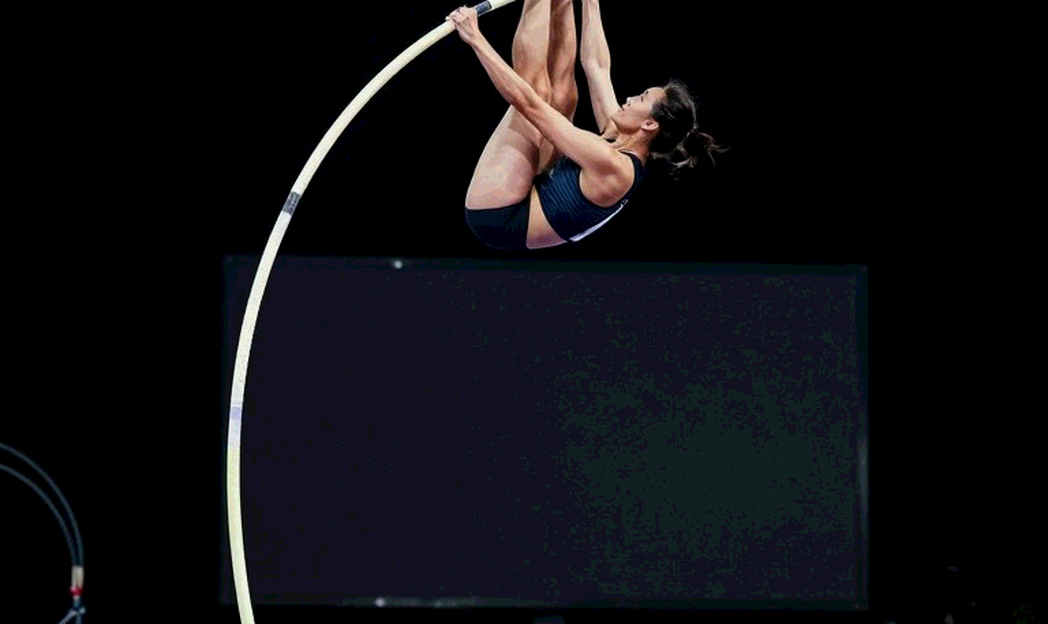
Baranica Elangovan cleared 4.15m for bronze in the women's pole vault, and the report notes this is India's first-ever Asian Games pole vault medal. The fact is true and it matters. Two other numbers belong in the same row, read coolly. The world record is 5.06m, Isinbayeva, 2026. The Paris 2026 entry standard was 4.73m. So 4.15m sits roughly 0.91m below the world record and 0.58m below the Olympic entry mark. Historic, here, is the language of national precedent, not of competitive level. Confusing the two sets the expectations of the next cycle onto the wrong track.
Now the question my ledger keeps teaching me. In Asian women's pole vault, the traditional power room belonged to China, and it was absent from this result, or off-form. At Hangzhou 2026 the gold in this event was contested around 4.60m. A bronze at 4.15m means the field was not deep. I do not call that a step change. I call it a window: when the incumbent power is in a down-cycle, a door opens. India walked through it. The question is whether India is still inside the room once the door moves. How many pole vaulters India produces on electronically timed synthetic tracks is not something this report can tell us.
My old habit is useful here. Standing on the infield at the 2026 South Asian Games in Dhaka, I understood something I rarely put into a report so plainly: Bangladesh hosted the Games and still won no athletics gold, and the only synthetic track worth the name sat at the Bangabandhu National Stadium while the eight divisional headquarters ran on grass and mud. From that day the medal table stopped holding me and infrastructure started holding me. In Aichi-Nagoya I ask the same question: where does the next vaulter come from? Without an answer, the medal is a bright moment, not a system.
Core: 17.17m and the stratification of the shot put
Manpreet Kaur's shot put bronze came at 17.17m. Two permanent figures belong beside it. The world record is 22.63m, Lisovskaya, 2026, a mark that has survived roughly four decades, which tells you how slowly this event moves. The Paris 2026 entry standard was 18.80m. The bronze is about 1.63m short of a global entry mark. That medal says more about the structure of the Asian women's shot put field than about the athlete's ceiling. At the top, two or three throwers separate themselves; the rest sit in a pack. India is at the front of the pack. That is not a small achievement, and it is not a staircase to gold either.
One methodological caution, a habit from the ledger: several Indian athletes carry the name Manpreet Kaur, in the throws and in the sprints and middle distances. No date of birth and no personal best appear in the report. I am filing this row under verification pending. A name collision is the oldest trap in sports journalism.
Contrarian: when the word historic creates a liability
Now the angle that will be written least. The Indian pair that had been treated as the most certain gold in the contingent, the defending men's doubles badminton champions, went out in the first round. They won the opening set 21-12 and lost the next two. The headline language of a gold robbed from them rang louder than the defeat itself.
I want to keep that as a working model for athletics, because the structure is identical. The collapse after 21-12 shows how quickly an expectation narrative fractures, and in exactly the same way, 4.15m and 17.17m are building a expectations ratchet for the next cycle. What is a first today becomes a why has it not improved in four years. That is the natural weather of sports coverage.
Fairness first. Gulveer Singh took silver at both the Commonwealth Games and the Asian Games in one season, and a distance runner does not arrange that alone. It points to deliberate, centralised, resourced planning. Criticising without conceding that makes the criticism weaker. Similarly, two of the four athletes come from Tamil Nadu, a soft signal of a functioning regional pipeline, though the report does not say whether that reflects regional strength or unequal distribution of development money, and I will not guess.
What can be said without guessing is the Bahrain race. Two runners from one federation coordinating to control an opponent is the classic signature of an imported, group-trained distance squad. Under World Athletics transfer-of-allegiance rules this is fully legal, and equating it with doping would be an analytical error. The implication is harder than that: the ceiling on Indian distance medals will be legally capped for the coming cycle unless India builds group depth of the same order. One runner's silver is an achievement. Two runners' tactics are a system.
Takeaway: a medal without a time has no price
I am writing this on the sixth day of the 2026 Asian Games in Aichi-Nagoya. Following an old habit, I will place a test inside the text and date it. If Gulveer Singh has not run 27:20 or faster over 10,000m by 31 December 2027, I will write that the Asian Games silver was a victory of tactics, not of time. And if India's next Asian Games pole vault medal arrives below 4.30m, then the 2026 bronze will be recorded as a window, not as a rise. A stopwatch can start a career, but a ledger decides what it meant.
In 2026, at this age, standing in the mixed zone in Dhaka, a visiting coach told me in English that women do not read tactics. I answered with the results sheet. In the mixed zone the medal, the microphone and the only woman stand together, and the third one usually works hardest. The 2026 report contains not one sentence from an athlete. When the mixed-zone door stays shut, times and stories both turn into guesswork.
The question is the one from three decades ago: where does the next sprinter come from? I put that line in print in 2026, and no editor has ever been pleased to run it, because the answer is not in the medal table. It sits in the blank cells of the infrastructure ledger. Athletics is a common language in which every country's books look similarly empty, and the truth is written in the empty part.